


The storm god Susano’o came down from heaven in a bad mood and found a family weeping by a river. A serpent had been eating their daughters, one a year, and was due back for the last of eight. The thing had eight heads and eight tails, eyes red as winter cherries, and a body long enough to cover eight valleys and eight hills. Susano’o offered to kill it for the girl’s hand. Then he did what any sensible person does before a fight he might lose: he got the monster drunk.
He set out eight vats of strong sake, one for each head. The serpent drank all eight, passed out, and Susano’o cut it apart. In the tail he found a sword. That sword became Kusanagi, one of the three sacred treasures of the imperial line, and this is why the story has been told for well over a thousand years.
Because the serpent is not a serpent. Read it the way the people of Okuizumo have always read it, and the legend turns into a mining report. The eight-headed beast is the river, running red and swollen with the iron sand washing down from the mountains. The sword in the tail is the steel those mountains gave up. Princess Inata, the daughter Susano’o saves, is the rice: once the slopes were stripped and dug out for iron sand, they were terraced and planted, and the fields fed the men who worked the forges. That’s Japanese efficiency; the trains have always run on time, so to speak.
There is a second, quieter origin story. The spirit of ironmaking is said to have come to Japan riding a white heron, settled on a katsura tree, and shown the locals how to make iron. People still leave offerings for that one at the Kanayago Shrine in Yasugi.
The iron sand
The work starts on the mountainside, with men chipping the slope apart to reach the sand. To sort the usable iron from the spoil, they run it through water on the riverbank and let gravity do the separating: the heavy grains sink, the rest washes away. These days they take only a little each year to protect the land.
Four days at the furnace
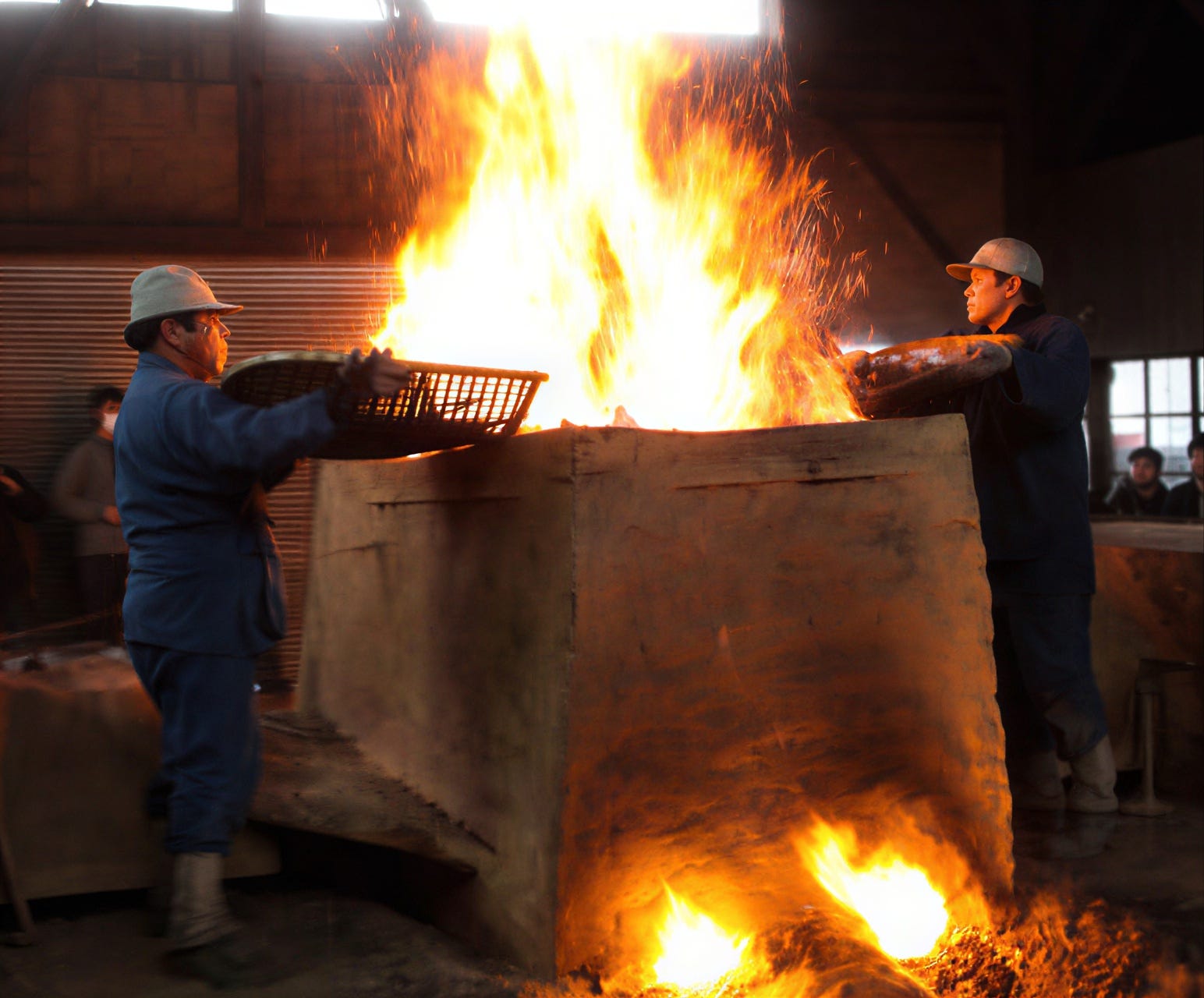
Then comes the tatara. Workers raise a furnace out of clay, big as a boat, and feed it charcoal and iron sand in turns. Foot bellows keep the air moving, men standing on them and pumping, hour after hour. A master called the murage runs the whole thing and does not sleep much, because the fire cannot go out. It burns for four days straight.
What comes out is a single block of crude iron called a kera, and you have to break it open to find what you came for. Inside is tamahagane, the clean high-carbon steel that swordsmiths across Japan have prized for centuries. One four-day burn and a wrecked furnace, for a few good chunks of steel. Nobody ever said it was easy.
Judged by eye, worked at night
A smith takes a piece of that steel, heats it in a charcoal forge, flattens it under a belt hammer, then shapes it by hand. The last step is the one that separates a blade from a bar of metal: hardening the steel at around 800 degrees. No thermometer. The smith reads the temperature off the color of the glowing steel and nothing else, which is why the hardening is done at night. In daylight, the color shift is too faint to trust. In the dark you can see it.
Where you can still experience Tatara
Almost all of this should be gone. When Japan industrialized under Meiji, modern steelmaking buried the tatara and the old method nearly died out. It came back because a few people refused to let it go. In 1977, they founded the Nittoho Tatara forge in Okuizumo, and it is now the only place in Japan still making tamahagane the traditional way. It sits out among the rice fields, quiet, and it is closed to the public. The artisans have enough to do teaching the next generation without an audience.
If you want to stand where the iron makers lived, go instead to Sugaya Tatara Sannai, in the Yoshida valley of Unnan. It holds the world’s last clay tatara forge, kept beside a clear river. “Sannai” means “in the mountains,” the term for the small iron towns that once held one or two hundred miners and the smelters. Sugaya is the only one of those towns, the kind where the workers actually lived, still standing.
Outside the sword museum in Okuizumo, a sculpture of the serpent rears up to meet whoever drives in. Eight heads. Eight tails. The river made a monster; it’s now keeping watch over the town.