


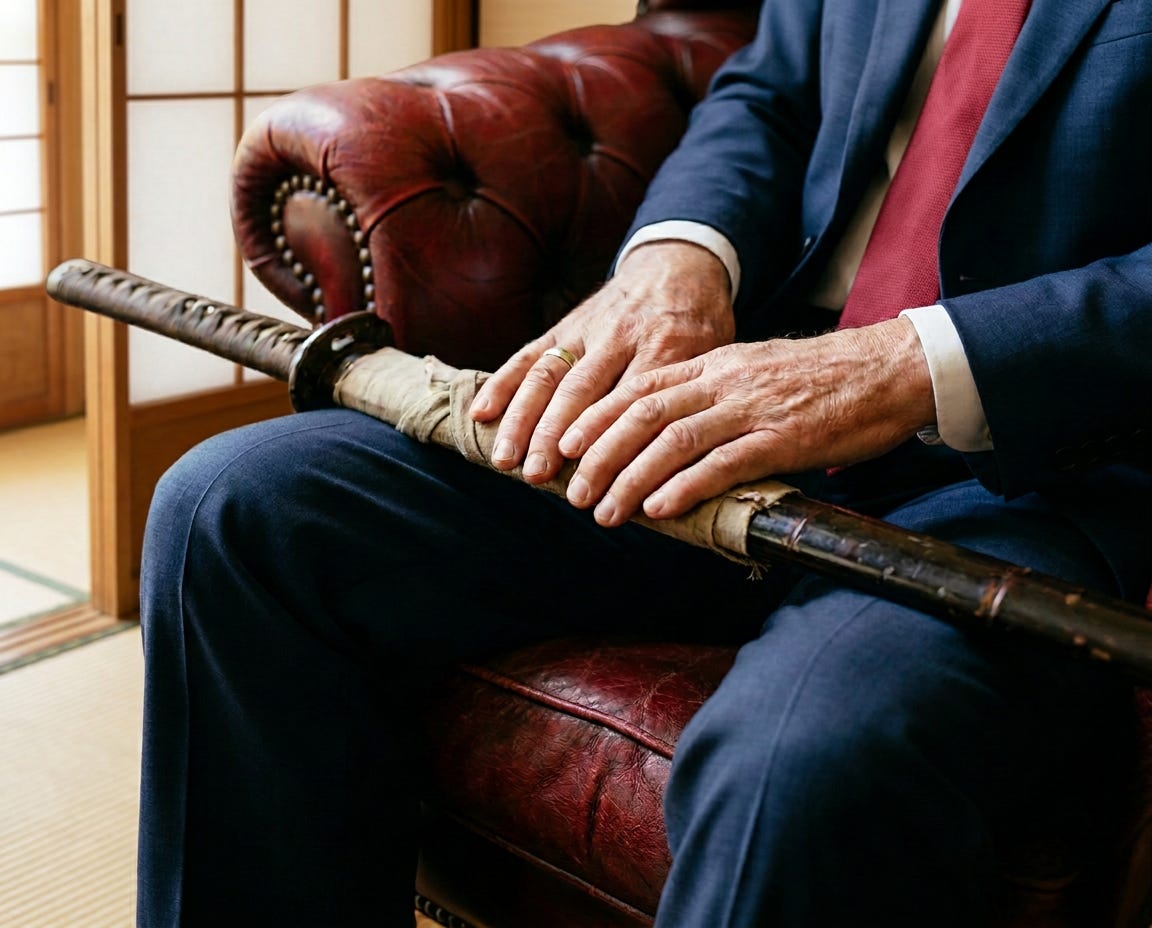
When I proposed to my Japanese girlfriend, I did not expect to end up here: kneeling on a tatami mat in front of a man who gave off competence and authority like a Yakuza boss, which I found out later he actually was, sort of. He was in his late sixties, close-cropped hair, sitting in a massive padded leather chair as if it were a throne. That in itself was fine. What wasn’t fine was the sheathed katana resting on his lap, which he kept lightly touching. It was a blade passed down from his samurai ancestors, hidden for decades after the Meiji government outlawed such weapons in public and dissolved the samurai class.
The man was my future wife’s father, and I was there to ask for his daughter’s hand in marriage. At that point, instead of walking away with a fiancée, I fully expected to be carried away missing a kidney or half my liver. Her entire family filled the large tatami room, waiting in silence. I was the only foreigner there, with no one on my side except my girlfriend, who stood just behind her father with a look on her face that said she didn’t know which way this was going to go either.
This all started in the mid-90s, which is when I got interested in Japanese culture. The Sci-Fi Channel is to blame. The anime Star Blazers was on, and I never missed an episode. I rushed home from work every day to catch it. I had always loved science fiction. I started reading it in junior high: Heinlein, Clarke, Asimov, all the old masters. I read Dune in eighth grade, a copy my father handed me because he’d given up on it. I loved every word. Then I found anime, started studying Japanese history and culture, and I was hooked.
My first wife passed in her mid-thirties from complications of diabetes. I was left to raise our seven-year-old son alone, and I did the best I could. I homeschooled him, and he’d banked enough credits to finish high school in three years. He joined the army at seventeen, with my permission.
Once I no longer had a child to raise, I started planning trips to Japan. I was the IT manager for a company that built software for power turbines. I got three weeks of vacation a year and spent at least two of them in Japan. I started studying Japanese and quickly realized I needed help. I met my future wife online: she was my Japanese teacher, I was her English teacher. We ran the lessons over video chat, and in time we learned a lot about each other. Once I could speak Japanese, badly, I decided to try for a job over there. I landed a position in Tokyo building English-language websites for a large gaming company.
I rented a room in what’s called a Gaijin House: a private bedroom with a shared living space, kitchen, and bathroom. It ran three hundred dollars a week, which in Tokyo is far less than a hotel, and an apartment is close to impossible for a foreigner to get anyway. The place was in Nippori, six stations north of Tokyo Station and under a ten-minute walk from Nippori Station. My commute to work took less than thirty minutes, which for Tokyo is astoundingly short.
The day after I arrived, I took the Shinkansen to meet my Japanese teacher in her hometown of Numazu, about forty-five minutes south of Tokyo. She was waiting just outside the platform exit in a denim miniskirt and the tall platform shoes that were in style then. She was in her mid-thirties but looked like a cute high schooler. She spotted me right away, ran over, and hugged me, which is very unusual for a Japanese person to do in public. It wasn’t love at first sight, we’d known each other online for about six months, but the thoughts running through my head right then had me wondering if I might not be alone much longer. I’d been alone for over ten years since my first wife passed, and I had figured I always would be.
She walked me to the lot where her spotless Toyota SUV was parked. I headed for the right side of the car. She laughed and asked if I was planning to drive. Then I remembered they drive on the other side of the road in Japan. My face went red, and I went around to the correct side. When I opened the door to get in, she asked me to take off my shoes; there was a set of slippers waiting on the floor for me. The inside of that car was so clean I assumed it had just come off the lot. She told me it was already a year old. She took very good care of it.
She drove me around her hometown, pointing out the sights. We ended up downtown on the shopping street, where she took my hand and led me, of all places, to a Denny’s. I ordered ebi soba with a side of sushi. She ordered spaghetti and meatballs. We both laughed at the irony, each of us reaching for the other’s country’s food. Afterward she drove me past her place, a large traditional Japanese home with a beautiful garden. Across the street was a park that had been the Emperor’s summer residence until World War Two.
Back downtown, she led me into an izakaya, a casual Japanese bar. This time she sat right next to me on the same bench seat. I hoped she couldn’t tell what that was doing to me. We had some snacks and a couple of beers, and then she took my hand again and walked me to a pachinko parlor. She managed a different parlor herself, and this one was the competition. She sat me at a machine and taught me to play. Half an hour later we were eight hundred dollars richer. First time playing, and I won that much. I knew right then this woman was going to be the luckiest thing in my life.
Like we were already married, she took six hundred and left me two hundred. “This is for our future dates,” she said. I didn’t argue, mostly because I had no idea how to. We were headed to Fuji-Q Highland the next day, and I was two hundred dollars richer regardless.
She came up to my room, and we talked for hours, until a typhoon rolling in sent her home before the weather turned. She hugged me for a long time and left. That night I could think about nothing but her and barely slept. The storm cleared before morning, and she arrived early for our trip. When she walked in, I hugged her and told her I loved her. Yeah, I know. Too soon. But she started shaking a little and hugged me harder. She didn’t say it back right then. It is very hard for a Japanese person to admit love that fast, but she showed me in a dozen other ways that she felt the same. We saw each other whenever we could over the next few months, which wasn’t often, since we both worked. We talked on the phone every day at around one in the morning, after she got off her shift.
I bought a ring, took her to a nice sushi restaurant, and proposed. She said yes, but first I had to meet her mother the following weekend. I was nervous, and it went far better than I expected. Her mother gave her blessing, so I figured I was in the clear. Nope. The real battle was just starting. Next, I had to get her father’s formal permission at a ceremony. She told me her mother would bring him around and that everything would be fine.
When I arrived, the whole family was waiting. I met her younger brother and his wife, both of whom spoke a little English, because the family owned a bowling alley at the big mall across town and hosted tournaments with visiting Americans. I was relieved that someone besides my future wife could understand me. The relief did not last.
They led me to the center of the large tatami room and asked me to kneel in seiza, the formal way of sitting back on your heels to show respect. Then the shoji doors at the far end slid open, and two men in blue suits and red ties carried in a very large leather-padded chair and set it down facing me. Her father walked in slowly and sat, wearing the expression of a samurai lord about to hand down a sentence. One of the men went to the back room and returned with a sheathed katana, which he laid across the father’s lap. He looked me over for what felt like an hour and was probably fifteen seconds. My fiancée took her place at his side and said, “Dozo.” Go ahead.
I bowed until my forehead brushed the tatami. A drop of sweat fell from my nose to the straw mat. I had memorized all the proper words and not one of them would come. I took a breath and finally managed to ask for his daughter’s hand in correct, polite Japanese. He sat there a moment, lightly touching the katana. Then he lifted it with both hands, one at each end of the sheath, and held it out to me. No one had told me what to do next, but I’d seen enough samurai movies to know: take the blade with your hands underneath it, and bow.
Then he said, “Wagaya e yokoso. Watashi no musume to kekkon shite mo ii desu yo.” Welcome to the family. You may marry my daughter.
The room erupted in laughter and cheers. I’d been had. They got me real good. It was the best-planned practical joke I’d ever been on the wrong end of, and the entire family was in on it. The ceremony itself was real, passed down through the family for generations. They just never warned me, and they played the menace to the hilt. My face must have been something to see. My father-in-law stood, shook my hand, and gave me a hearty pat on the back. From that moment I was family, never again the foreigner in the room. That was twenty-one years ago. Best practical joke anyone has ever pulled on me, and I married into it.
This Substack is about Japan. The history, culture, traditions, and the oishii food! I will be writing about our extensive travels around the country and teaching tips that will make your trip there more interesting and memorable. From time to time, I will be posting free short stories from my Alternate History SciFi series that starts in 16th-century Japan. Please sub and help me grow!
!