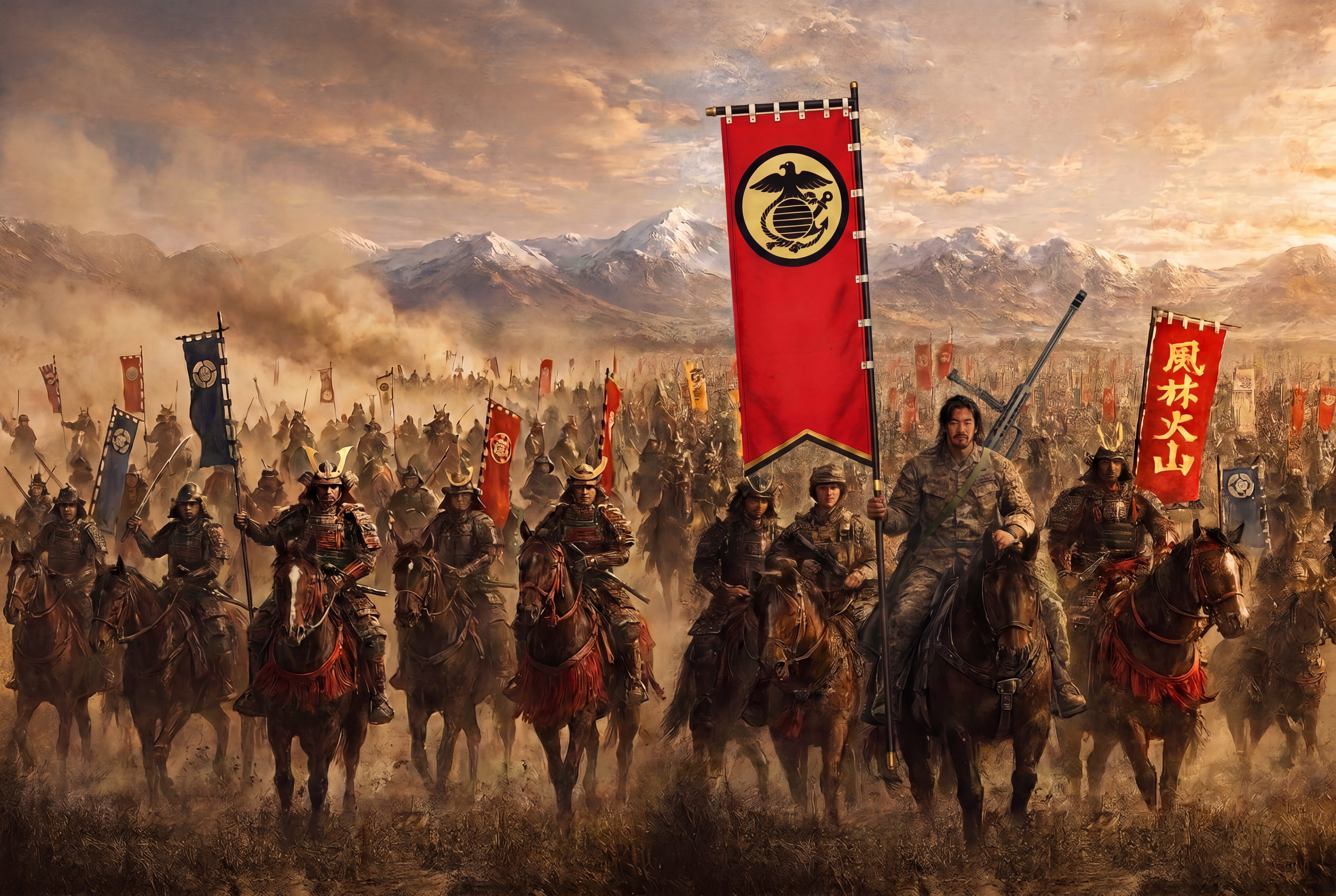
I was working on the cover of my second novel in the Reality Meld Saga, Fūrinkazan, and I needed a war banner, a sashimono, for one of my protagonists.
This is the banner I designed for Stan Maddox.
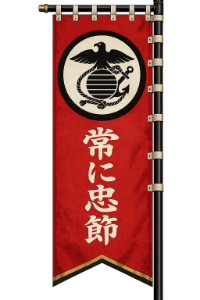
Stan is a retired Marine long-range shooter who gets pulled out of modern Idaho and dropped into 1575 Japan, forty-nine days before the meld closes in an apocalyptic disaster if not stopped. By the end of the first book, he has sworn himself to the Tokugawa, and a sworn man rides under a standard. So I gave him one. Two words, big and clean. Semper Fidelis.
My wife looked at it for about two seconds, put her hand to her mouth, and shook her head.
“That would look silly,” she said.
She’s Japanese. When she says a thing about her own history in that flat, certain way, I have learned to stop and ask why before I argue. So I asked.
The short version: nobody in 1575 would have written that on a flag.
Here is the part that surprised me. It isn’t that sentence-length banners didn’t exist. They did. Sengoku commanders flew sashimono with real phrases on them, some of them long. The problem was never the length. It was the kind of sentence.
A battle standard in that period pulled its words from a short list. It invoked a god. It quoted a Chinese military classic, it stated a religious position, or it carried the clan crest (mon) and name. What it did not do was announce the bearer’s own good character in plain modern language.
Two of the famous ones show the idea.
Takeda Shingen flew four characters, 風林火山, *Fūrinkazan*. Swift as wind, quiet as forest, fierce as fire, immovable as mountain. It reads like a full thought, and it is, but the weight comes from the source. Those lines are lifted straight out of Sun Tzu. A commander riding under them isn’t bragging. He’s quoting the oldest authority on war there is.
Tokugawa Ieyasu, flew something even longer. 厭離穢土欣求浄土, Onri Edo Gongu Jōdo. Abhor this defiled world, aspire to the Pure Land. A temple master wrote the words for Ieyasu when he was young and considering suicide, and Ieyasu carried them for the rest of his life. That is a sentence on a flag. It is also a Buddhist vow.
So set “Semper Fi” next to those.
Loyalty, 忠, chū, was the assumed floor of being a vassal. It was the water the whole system swam in. Painting it on your own banner is like a soldier stitching “I follow orders” onto his jacket. Everyone around him already assumes that. Saying it out loud makes them wonder why he felt the need. The phrasing gives it away too. That crisp adjective-and-adverb construction is the shape of a Western regimental motto, and it lands in a Japanese war camp like a truck horn at a tea ceremony.
She was right. It looked silly.
The fix was easy once I saw the rule. If Stan wants loyalty on his standard, the period gives him better tools than a slogan.
He could fly a single character. One bold 忠, and nothing else. That’s squarely in the tradition. Uesugi Kenshin rode under a single 毘 for the war god Bishamonten, and a lone character reads as confident, not boastful.
Or he could reach for a classical idiom, the *Fūrinkazan* move. Or 尽忠報国, jinchū hōkoku. Devote your loyalty, repay the realm. Four characters, drawn from an old Confucian-military phrase tied to a Chinese general who is still a byword for faithfulness. It says everything Semper Fidelis was trying to say, in the register the century actually used.
But here is what I actually did with the mistake. I decided to use it.
Because think about who Stan is. A modern man with an old soldier’s reflexes, handed a banner and asked what he wants on it. Of course he reaches for the motto he served under, Semper Fidelis. That reflex is true to him. Cutting it would smooth away exactly the kind of friction that makes a fish-out-of-water story work.
So the error will go into the book. Stan will ask for his two words. A Tokugawa retainer, or his wife Yumi, stops him the way my wife stopped me, and walks him back to a single character, or simply to use the new house mon. The reader learns about Japanese culture by watching a man bump into it, hard. Stan ends up somewhere that is both correct for 1575 and yet still happy with the outcome.
The banner in the finished book is a simple mon based on the U.S. Marine Corps flag. There were mon more complicated than the one used on Stan’s sashimono, so reproduction during Sengoku would be easily possible. Stan didn’t choose it on his own. Someone had to talk him into it, the same way my wife talked to me about it, and I thank her dearly for not letting me look like an anachronistic chucklehead.
This is the cover image of Fūrinkazan that I ended up using. It is now my Windows wallpaper: